Jan Lutma, Goldsmith
Rembrandt Van Rijn
Jan Lutma, Goldsmith
etching
1656
An original Rembrandt Van Rijn etching.
1656
Original etching, engraving and drypoint printed in black ink on laid paper
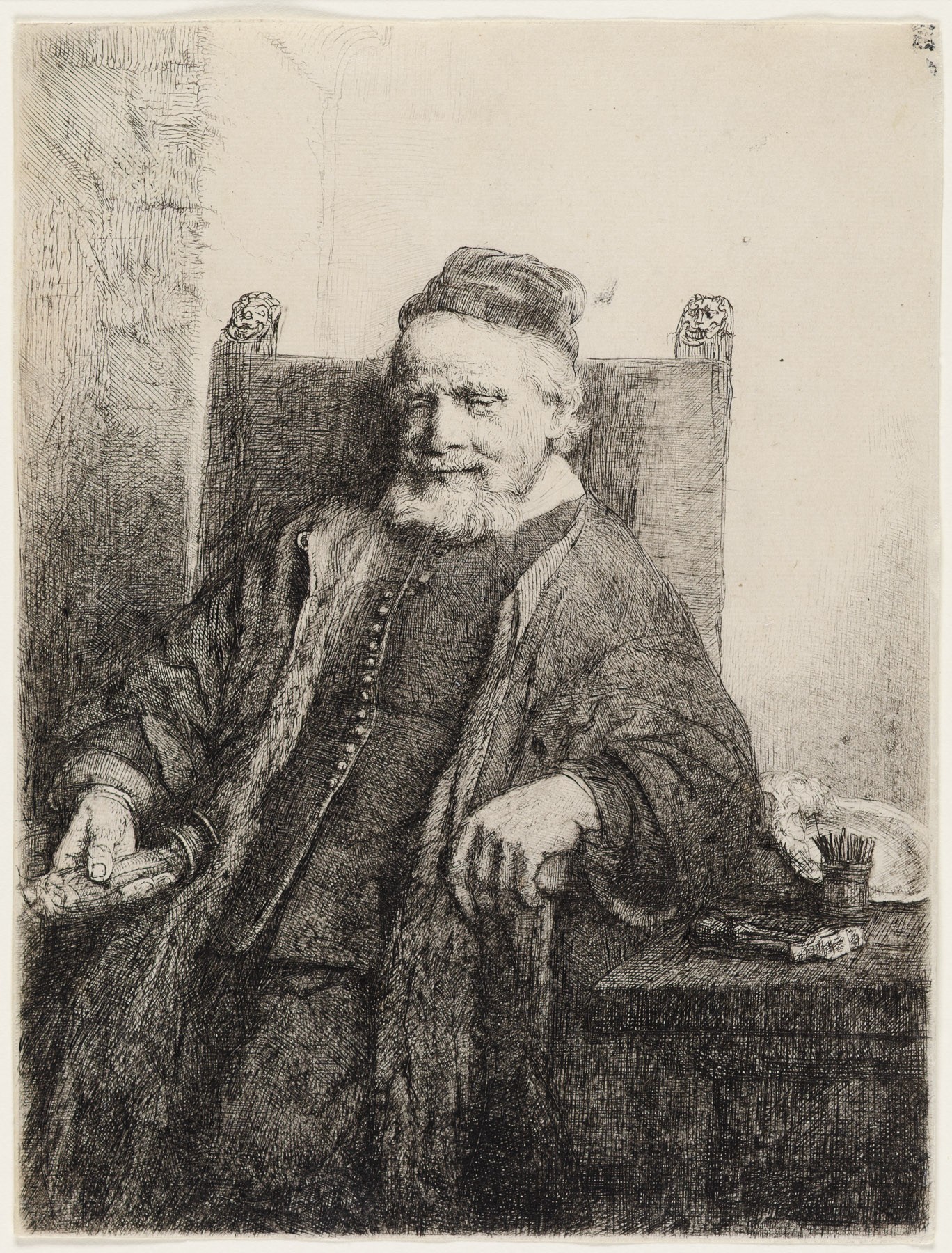
A superb 17th century/lifetime impression of Bartsch’s first state of three, Usticke’s first state of six, New Hollstein’s first state of five, printed prior to the addition to the plate of the window behind the sitter along with the artist’s signature and date.
Catalog: Bartsch 276 i/iii; Hind 290; Biorklund-Barnard 56-C; Usticke 276 i/vi; New Hollstein 293 i/v
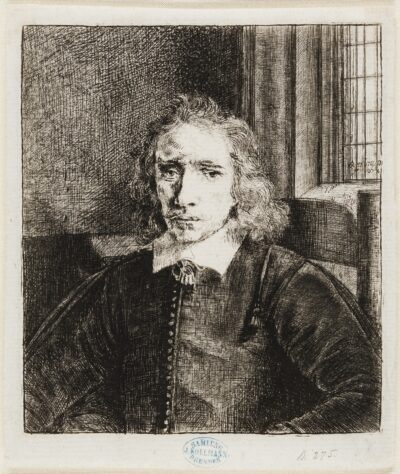
In this 1656 portrait of the eminent gold and silversmith Jan Lutma, the 72 year-old Lutma is seated in the same high-backed chair decorated with lion heads that provides the seating for the portraits of two other elderly sitters, Thomas Haringh (Bartsch 274) and Arnold Tholinx (B. 284). On the draped table to Lutma’s left are a hammer and a container of metal punches, tools of his trade. Behind them is a silver drinking bowl in the Dutch biomorphic or “lobate” style of metalwork of which Lutma was one of the greatest practitioners. Lutma holds in his right hand another example of his craftsmanship, perhaps the figural base of an ornamental wine cup or candlestick. Lutma’s head, with its complex expression, is dramatically illuminated. Lutma’s gaze is averted, reflective, his eyes cast down. One has the sense from Lutma’s contracted brow and the ambiguous play of shadow over his features that these are the outward manifestations of a powerful interior life. Whether Lutma might be conceiving new designs for metalwork or pondering the struggles of his long artistic career is impossible to say, but one nevertheless has the sense that the physical relaxation of Lutma’s body is accompanied by lively mental action.