Irving Penn
(American, 1917-2009)
Biography
Irving Penn was an American photographer well known for his fashion photography, portraits, and still life photographs. Penn’s career included work at Vogue magazine, and independent advertising work for clients including Issey Miyake, and Clinique. His work has been exhibited internationally, and continues to inform the art of photography even after his death. While perhaps best known for his fashion photography, Irving Penn’s repertoire also included portraits of creative greats; ethnographic photographs from around the world; modernist still lifes of food, bones, bottles, metal, found objects, etc.; and scenes from photographic travel essays. Penn is considered a giant of late-20thcentury traditional photography.
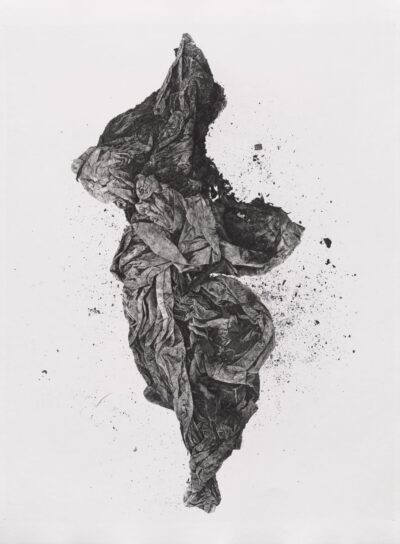
In 1977, Irving Penn had an exhibition titled Street Material mounted by the Metropolitan Museum of Art. The photographs, taken in 1975 and 1976 were images of old gloves, twisted paper, a paper cup or cigarette butts using platinum paper with its special sheen and sensual appeal. These images photographed in front of a plain background, challenged the traditional idea of beauty and gave dignity to the discarded trash he rescued from the Manhattan streets. Twisted Paper, Neg III is from that body of work. Twisted Paper, Neg III, is a platinum print, which has an especially sensual surface. Penn would spend countless hours in his studio creating prints with expensive platinum salts – a process that had been mostly abandoned at the turn of the 20th century, but favored by Penn because of its lustrous results. (Most photographic prints use a solution of silver on the paper rather than platinum.) Penn would paint the platinum solution on the paper himself to create the effects he sought. Penn stated, “Over the years I must have spent thousands of hours silently brushing on the liquid coatings, preparing each sheet in anticipation of reaching the perfect print.”
Henry Geldzahler, past curator of the Metropolitan Museum of Art described the Street Material as “subjects that have been exposed not only to the elements, but to the brutal indifference of urban life.” Penn “entices the viewer to examine it as if under a microscope. We are introduced to a realm of highly suggestive abstract imagery abounding in the unexpected.”