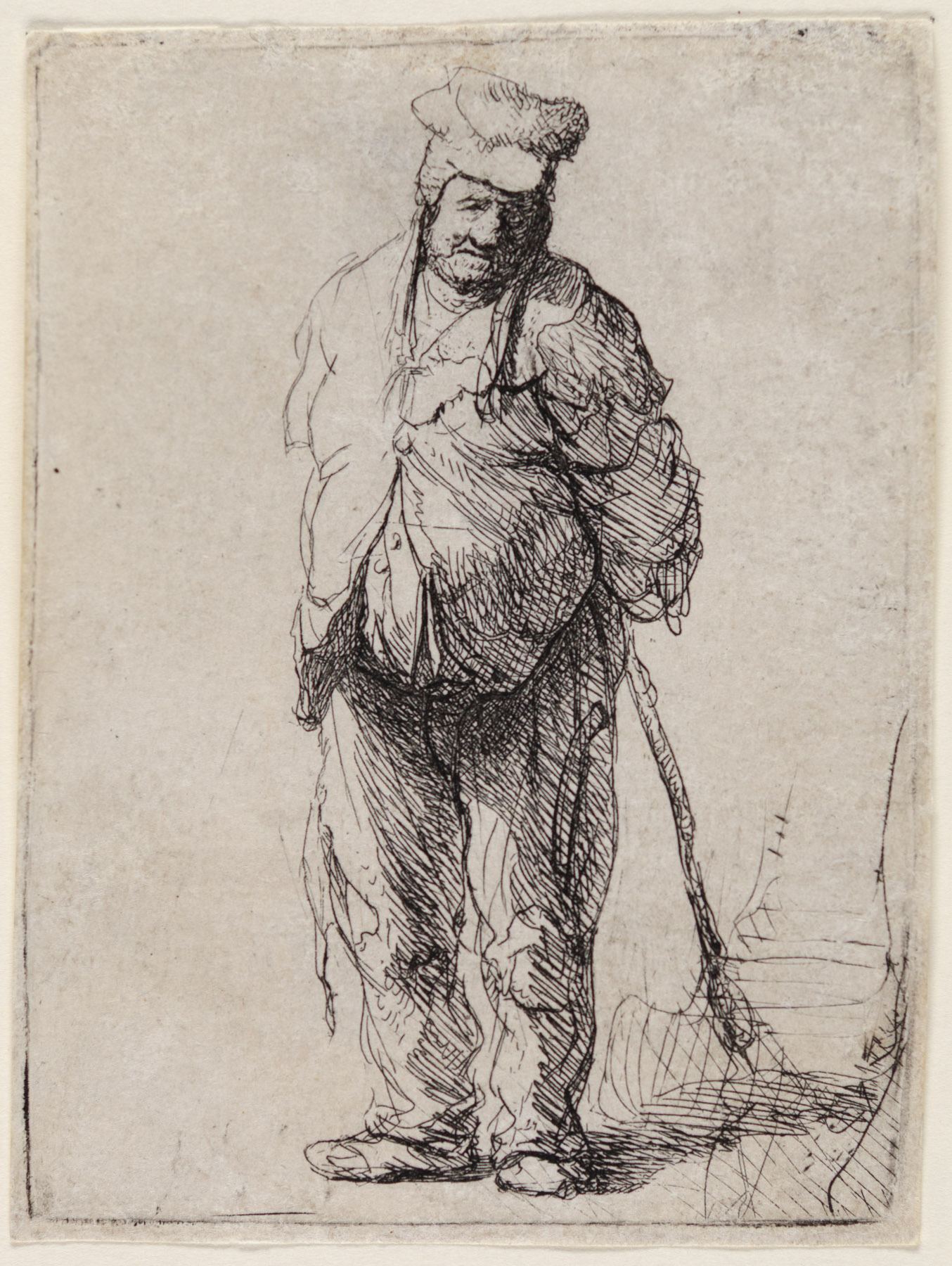

Ragged peasant with his hands behind him, holding a stick
Rembrandt Van Rijn
Ragged peasant with his hands behind him, holding a stick
etching
c. 1630
An original Rembrandt Van Rijn etching.
c. 1630
Original etching printed in black ink on laid paper
A superb 17th century/lifetime impression of Bartsch and Usticke’s fifth state of six, New Hollstein’s eighth state of nine, of this scarce etching (characterized by G.W. Nowell-Usticke in his 1967 catalogue Rembrandt’s Etchings: States and Values, as “very rare,” and given his scarcity rating of “RRR” [30-50 impressions extant in that year]), printed prior to the addition of the pillar and arch to the right of the man.
Catalog: Bartsch 172 vi/vi; Hind 16; Biorklund-Barnard 30-7; Usticke 172 vi/vi; New Hollstein 47 viii/ix
During the Leiden years, from about 1629 to 1631, Rembrandt etched a large number of small plates of varied dimensions representing street people and beggars. These were inspired in part by the internationally known and much copied series of twenty-five beggar etchings by the Lorraine etcher Jacques Callot, first published in Nancy about 1622-23. Rembrandt’s earliest attempts in this genre tend to reflect the influence of Callot in technique as well as theme. Very quickly, however, Rembrandt moved in the direction of greater detail. In the years 1630-31 Rembrandt produced a rather large number of small study sheets of beggars, though the results cannot be considered a “series” like Callot’s.
We can only guess at Rembrandt’s deeper reasons for creating so many etchings of beggars. Whatever his motivation may have been, however, it soon became clear that the public was delighted with this new genre. Scholars have often interpreted the series as a deeply felt commentary on social injustice and a gesture of solidarity with the poorest of the poor.